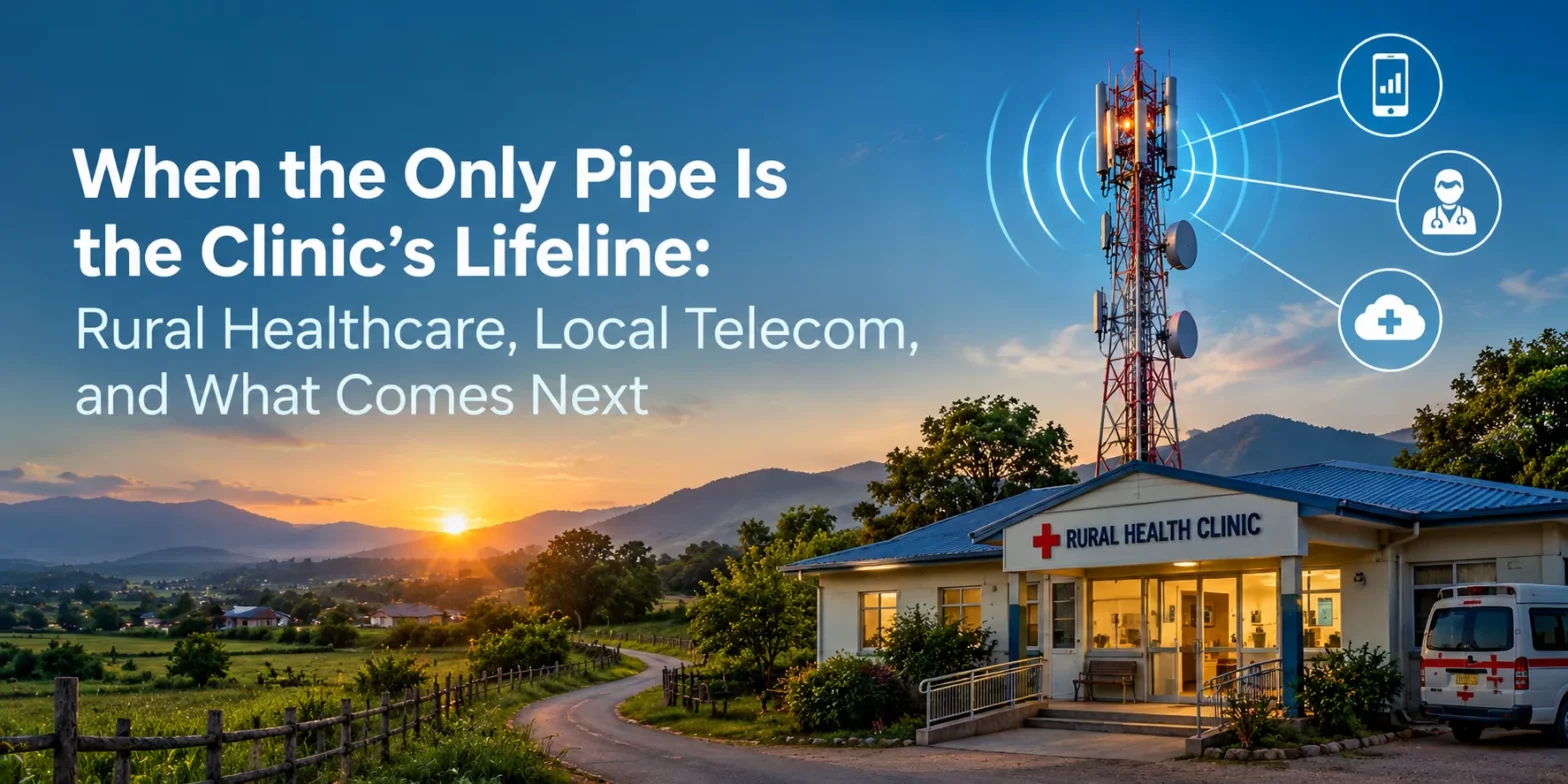
Rural healthcare doesn’t fail the way a large system does. Often, there is one hospital, one clinic group, one ambulance service, and one regional telecommunications provider. When that provider is compromised or goes dark, the next option is not another campus across town. It is delayed care, diverted patients, and a community that has already been told digital access would close the distance.
Jewelbug made the method plain. The group did not break into each ministry. It compromised the shared web-hosting platform of a state telecom and reached more than 15 government tenants with one script. Rural medical centers, critical access hospitals, pharmacies, home-health agencies, and county EMS units are often tenants on the same kind of shared layer: one rural carrier, one electric-cooperative broadband network, or one wireless internet provider.
The rural hospital story is no longer mainly about buildings going dark overnight. Complete closures slowed after the last decade’s wave. What continued is the loss of the services those buildings used to provide. Many rural hospitals lose money on patient care. Independent analyses in 2026 put hundreds of facilities in financial distress, with a smaller set at immediate risk of closing. More telling for patients is what has already left. Only about two in five rural hospitals still deliver babies; hundreds have dropped obstetrics, general surgery, or chemotherapy. In many counties the hospital is still on the map, yet the care is not.
Workforce is the other half of that picture. Rural communities have far fewer clinicians per capita than urban ones. Primary-care shortage designations remain concentrated in rural areas. Nurse practitioners and physician assistants now deliver a large share of local care because physicians are scarce. Information technology and security staff are even thinner. Two to five people often handle work that larger systems assign to an entire department, using systems not designed for today’s volume of telehealth and data exchange.
That is the setting in which the network matters. Capacity is short. Specialty depth is short. The remaining services—emergency coverage, transfers, video consultations, e-prescribing, and charts that must arrive before the ambulance—depend on a network the clinic does not control.
The connection is no longer only a phone line. It carries telehealth visits and specialist consults that keep stroke, trauma, behavioral health, and obstetrics from becoming a two-hour drive. It carries electronic health record sessions, e-prescribing, health information exchange queries, and imaging. It carries after-hours nurse lines, billing, eligibility checks, and the transfer packet the receiving hospital needs before a patient leaves the bay. In many counties, it also carries the path into 911 and next-generation 911.
Private citizens in those counties use the same networks to reach a portal, a pharmacy, or a visiting nurse. The clinical load sits on organizations that already operate with thin staff and little spare capacity.
A ransomware event inside a rural hospital is now a familiar story. Less often named is the carrier underneath it.
If that carrier’s email can be spoofed, staff and patients receive invoices, password resets, and “required updates” that look local and trusted. If someone can take over dangling DNS records, they can stand up a site that looks like the clinic portal. If known-exploited vulnerabilities and management interfaces sit on the public internet, the people who maintain the pipe can be reached the same way Jewelbug reached a shared webmail platform.
The harm is practical. A rural hospital that cannot send a scan or open a chart cannot complete a transfer. An ambulance service that cannot reach medical control loses time it does not have. A clinic that cannot complete an e-prescribe leaves a patient without medication until someone drives to town. Because these facilities are often the only source of care for miles, the blast radius is the county, not a single department.
Federal and state programs are also putting new money into rural digital care. The Rural Health Transformation Program is sending $50 billion to the states through 2030, and state plans lean heavily on telehealth, remote monitoring, and health information technology. The FCC Rural Health Care Program continues to support clinical connectivity. Those investments expand the number of clinical sessions that ride the same thin networks. They do not, by themselves, produce a public view of the carrier’s external posture. Broadband and telemedicine dollars without that view shift risk onto patients in the counties with the fewest alternatives.
Hospitals are regulated for privacy and security. Telecom operators face federal and state oversight that is real and uneven. Neither regime produces a consistent, side-by-side view of a carrier’s external posture that a hospital board or a county commission can use.
National hospital and rural health associations are actively addressing rural care. Their 2026 agendas focus on payment, Medicaid, 340B, workforce, maternal access, and the policies that keep critical access and rural emergency hospitals open. That work is essential, but it also leaves telecommunications risk as a footnote. Their priority is solvency, while the network supporting the growing digital workload is treated as someone else’s responsibility.
Most U.S. telecom operators have fewer than 50 staff. Rural hospitals run equally lean on the technology side. The two systems converge in the same counties where transformation plans are adding virtual care. That meeting is the unpriced patient-safety risk.
This is not a list of fixes. It is a list of decisions.
Hospital and clinic boards can put the carrier on the agenda and ask the same five questions used for any other vendor that touches clinical operations: Can anyone send mail that looks like yours? Have you closed the vulnerabilities CISA already says attackers use? Have credentials tied to your company appeared on the dark web? Do you have leftover DNS records that attackers can hijack? Which management interfaces are on the public internet?
State rural health associations and hospital associations can treat telecommunications external risk as part of transformation planning, not as a footnote under broadband. If Rural Health Transformation Program and FCC Rural Health Care Program dollars are going to increase clinical traffic on these networks, the plans should be able to ask whether the path is visible, not only whether the circuit is funded.
County commissions, state utility staff, and emergency-management directors can ask for comparable external assessment of the providers that carry dispatch, 911, and hospital traffic. An attestation is not the same thing as an outside view of dangling DNS, known-exploited vulnerabilities, and exposed services.
Members, administrators, and clinicians who already write to senators, CMS, and FCC staff can add one sentence to work they are already doing: connectivity spending that does not require a visible external baseline leaves rural patients holding risk the facility cannot staff its way out of.
The method is no longer obscure. A shared telecommunications layer can be the shortest path to many tenants at once. Rural healthcare is organized around exactly that kind of layer. You know that now. The next question is who you will ask on Monday, and whether you will accept a vague answer.
[1] Symantec Threat Hunter Team. (2026, August). Jewelbug campaign reporting on shared telecom web-hosting used to reach multiple government tenants.
[2] SureShield and BorderHawk LLC. (2026). US Telecommunications Sector Report: 2026 Cyber Risks, Threats & Guidance. https://us-telecom-cybersecurity.sure-shield.com/index.html
[3] Chartis. (2026). 2026 Rural Health State of the State.
[4] Center for Healthcare Quality and Payment Reform reporting on rural labor and delivery closures (2026).
[5] Rural Health Information Hub. Cybersecurity for Rural Healthcare Facilities.
[6] Health Sector Coordinating Council. On the Edge: Cybersecurity Health of America’s Resource-Constrained Health Providers.
[7] American Hospital Association. 2026 Rural Advocacy Agenda; cybersecurity resources for rural hospitals.
[8] National Rural Health Association. 2026 advocacy priority areas.
[9] Centers for Medicare & Medicaid Services. Rural Health Transformation Program.
[10] Federal Communications Commission. Rural Health Care Program / Promoting Telehealth in Rural America.
[11] HRSA Bureau of Health Workforce. Health Professional Shortage Area statistics and workforce projections.