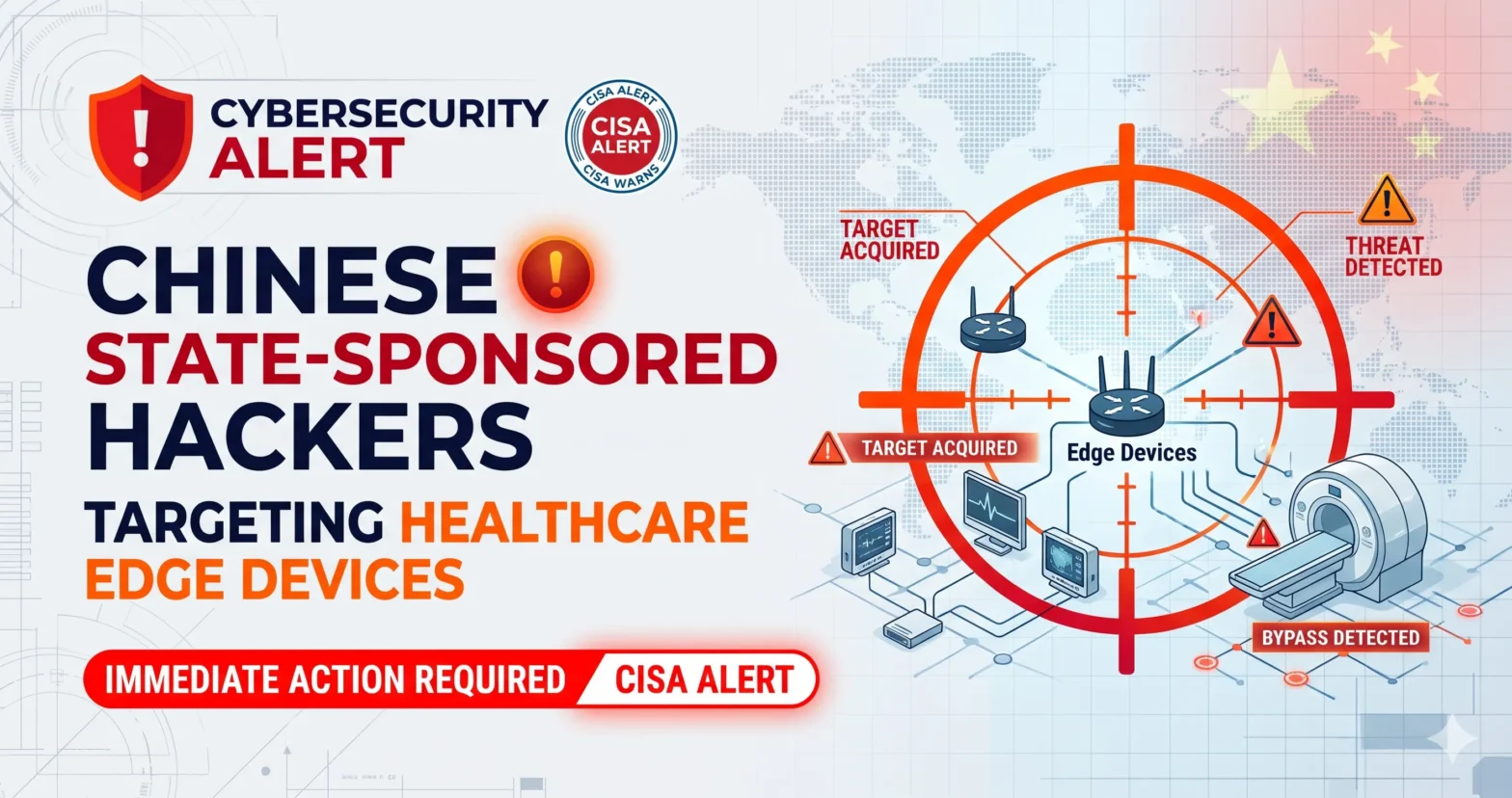
Chinese government-linked cyber threat actors are actively targeting healthcare organizations. Is your internet-facing infrastructure vulnerable?
On October 8, 2026, CISA, the FBI, the NSA, and international partners issued Joint Cybersecurity Advisory AA26-281A, warning that Chinese state-sponsored actors are systematically scanning healthcare and critical infrastructure networks for known vulnerabilities.
The campaign combines automated vulnerability scanning, hands-on exploitation, credential theft, and covert persistence to compromise organizations worldwide.
For healthcare security teams, the warning is clear: unpatched edge devices, exposed remote-access systems, and overlooked internet-facing assets can become entry points for sophisticated cyberattacks.
Here is what the advisory reveals, which vulnerabilities matter, and how organizations can reduce their exposure.
CISA Advisory AA26-281A, Chinese Government-linked Cyber Threat Actors Combine Automated and Hands-on Hacking Tools to Steal Sensitive Data, documents a campaign targeting Healthcare and Public Health, Government Services, Critical Manufacturing, and Information Technology.
The activity is associated with Chinese government-linked actors supported by Integrity Technology Group, a China-based cybersecurity company with documented government ties.
Researchers associate the observed tactics, techniques, and procedures (TTPs) with Flax Typhoon, Ethereal Panda, and Red Juliett.
The attackers are not relying exclusively on sophisticated zero-day exploits. Instead, they are systematically identifying and exploiting known vulnerabilities in internet-facing infrastructure.
That makes vulnerability visibility, patch management, and external attack surface monitoring essential defensive priorities.
The advisory describes a four-stage attack chain.
Since 2017, attackers have reportedly used MicroScan, a Python-based tool containing more than 1,300 penetration-testing scripts.
It scans internet-facing services for vulnerabilities in products including OpenSSL, Oracle WebLogic, WordPress, Juniper ScreenOS, Jenkins, and Apache Struts.
When vulnerable services are identified, attackers exploit them using cross-site scripting (XSS), password spraying against Microsoft Exchange, or direct CVE exploitation.
Attackers install legitimate SoftEther VPN software to maintain access to compromised systems. Installers may be renamed conhost.exe or dllhost.exe to resemble normal Windows processes, making suspicious activity harder to distinguish.
The actors steal account credentials and extract email data from on-premises and cloud environments. Confirmed victims include healthcare systems, government organizations, law enforcement agencies, and religious institutions.
The campaign demonstrates why identifying vulnerabilities alone is insufficient. Organizations also need visibility into exposed assets, compromised credentials, and suspicious persistence mechanisms.
The advisory identifies eight vulnerabilities successfully exploited by the actors.
| CVE | Product | Vulnerability |
| CVE-2014-6278 | GNU Bash | Remote code execution |
| CVE-2015-3306 | ProFTPD 1.3.5 | Unauthorized read |
| CVE-2015-5477 | ISC BIND 9.x | Denial of service |
| CVE-2016-3081 | Apache Struts 2.3.x | Remote code execution |
| CVE-2019-11510 | Pulse Connect Secure | Unauthorized read |
| CVE-2021-22205 | GitLab | Remote code execution |
| CVE-2021-3199 | ONLYOFFICE DocumentServer | Unauthorized write |
| CVE-2023-22894 | Strapi | Information disclosure |
Several vulnerabilities date back years, highlighting the persistent risk posed by legacy systems and inconsistent patch management.
Organizations should compare deployed software against the CISA Known Exploited Vulnerabilities (KEV) Catalog and prioritize applicable vulnerabilities based on exposure, exploitation evidence, and business impact.
Find and Prioritize Vulnerabilities Before Attackers Do
Explore SecurityShield-TVM for vulnerability identification, risk prioritization, remediation workflows, and verification of vulnerability fixes.
Healthcare cybersecurity presents three significant challenges.
EHR components, DICOM servers, medical devices, and network appliances often remain operational for years. Patching must account for clinical availability and patient safety, leaving some vulnerabilities unresolved longer than expected.
Healthcare organizations frequently expose VPN gateways, telehealth portals, remote access servers, web applications, and device management platforms.
Every externally accessible service running vulnerable software represents a potential attack path.
Healthcare records, research data, credentials, and operational systems are valuable intelligence targets.
CISA also warns about state-sponsored actors positioning themselves inside critical infrastructure networks, including operational technology (OT), to potentially disrupt critical functions later.
The consequences extend beyond data breaches to operational disruption and patient care.
Healthcare security teams should prioritize the following actions.
You cannot remediate vulnerabilities on assets you have not identified.
SureShield’s Free Baseline Scan helps organizations assess external exposure, identify potential vulnerabilities, and receive prioritized remediation guidance.
Effective defense requires more than patching.
Vulnerability management: SecurityShield-TVM supports vulnerability discovery, CVE intelligence, and remediation prioritization.
Sensitive data visibility: SecurityShield-DLP supports sensitive data fingerprinting, enterprise data mapping, exposure visibility, and compliance-focused eDiscovery.
Dark web surveillance: SecurityShield-DWS helps organizations monitor compromised credentials and sensitive organizational information exposed through dark web activity.
Endpoint policy validation: SecureTrust supports endpoint configuration validation, policy enforcement checks, CIS Benchmark alignment, and remediation guidance.
Together, these capabilities support a more structured approach to cybersecurity risk management and control validation.
Explore the SecurityShield Cybersecurity Platform
The biggest challenge exposed by AA26-281A is often a governance gap: organizations know vulnerabilities exist but lack a repeatable process to close them quickly.
A mature cybersecurity program needs:
SureShield helps healthcare organizations strengthen cybersecurity governance, risk management, and compliance through technology and cyber maturity initiatives.
For healthcare organizations: Explore Healthcare Cybersecurity Solutions
For MSPs and MSSPs: Explore SureShield Partner Solutions
For defense contractors: Explore Defense Industrial Base Cybersecurity
It refers to cyber operations attributed to Chinese government-linked actors targeting healthcare infrastructure, sensitive information, and internet-facing systems through vulnerability exploitation, credential theft, and persistent network access.
Integrity Technology Group is a China-based cybersecurity company identified by U.S. authorities as supporting offensive cyber operations through vulnerability scanning tools, spear-phishing capabilities, and infrastructure.
Flax Typhoon is a designation used to track Chinese government-linked cyber activity. CISA AA26-281A describes techniques consistent with Flax Typhoon, Ethereal Panda, and Red Juliett.
Verify internet-facing asset inventories, identify affected software versions, prioritize exploited CVEs, enforce phishing-resistant MFA, and establish accountable remediation timelines.
A baseline assessment can help identify externally visible assets and potential vulnerabilities. Organizations can begin with SureShield’s Free Baseline Scan.
CISA AA26-281A reinforces a critical reality: known vulnerabilities become serious security risks when organizations cannot identify, prioritize, and remediate them consistently.
Healthcare security teams must move beyond reactive patching toward continuous visibility, measurable remediation, and stronger cybersecurity governance.
SureShield helps organizations strengthen vulnerability management, data protection, dark web surveillance, and security policy validation.
Know your exposure. Prioritize remediation. Strengthen your security posture.