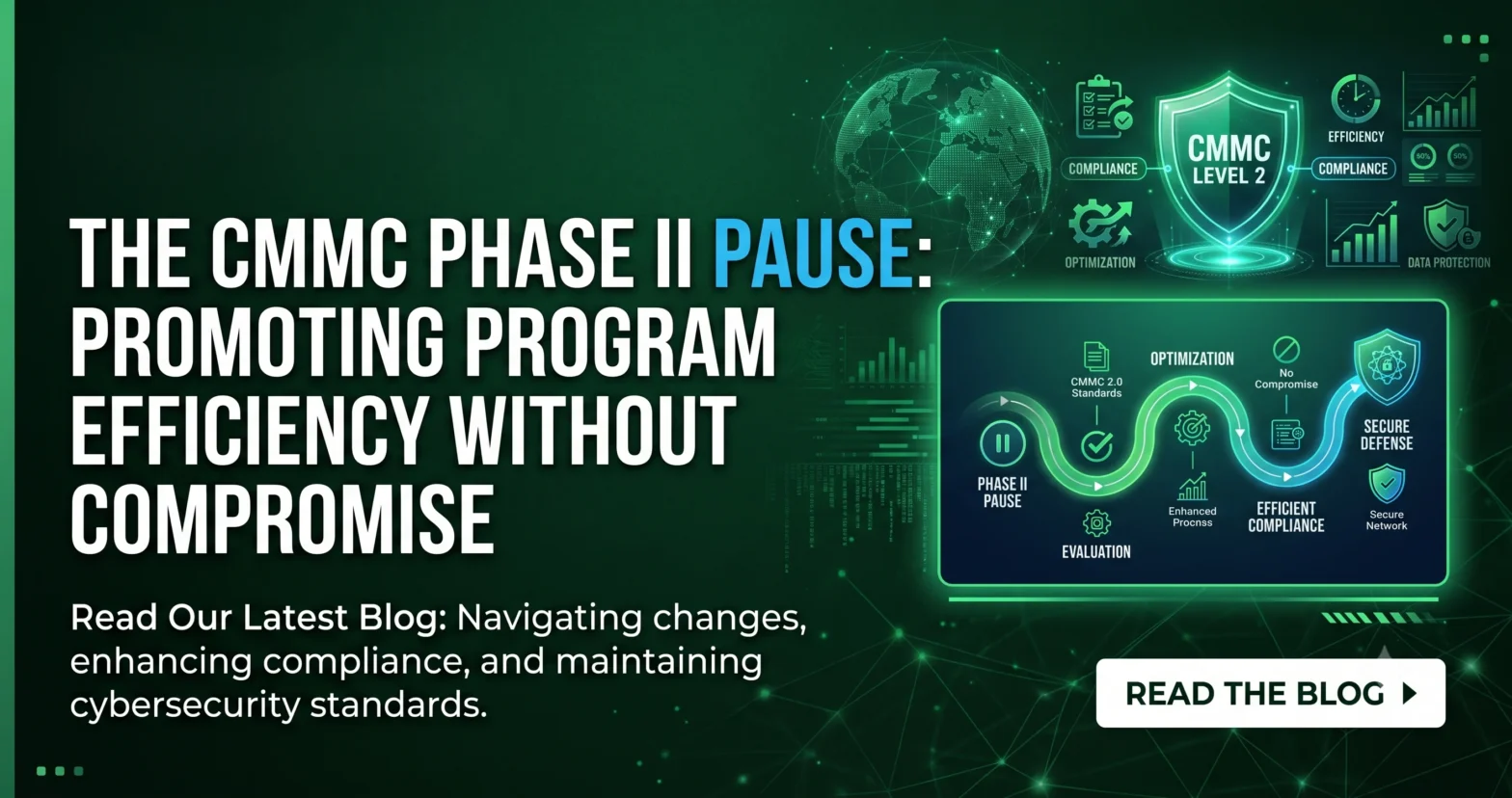
This summer, the Department of War suspended CMMC Phase II and established a Reform Task Force. For Defense Industrial Base, technology, and cybersecurity professionals, this pause offers breathing room and a timely opportunity to strengthen the controls that matter most.
This is not an isolated delay. It reflects a broader effort to reduce unnecessary processes, make it easier for smaller and non-traditional organizations to participate, speed up delivery of real capability, and shift the focus from rigid checklists toward practical cybersecurity. The duty to protect Controlled Unclassified Information (CUI) and Federal Contract Information (FCI) has not changed. What is changing is the recognition that more process is not always better process, and that simplifying bureaucracy is preferable to expanding it.
On July 13, 2026, the Department of War suspended the move to CMMC Phase II. That phase would have required third-party (C3PAO) Level 2 assessments for applicable contracts starting around November 10, 2026. Later milestones were also put on hold.
Phase I self-assessments remain fully in force. Contractors must still implement and maintain NIST SP 800-171 Rev. 2 controls, post accurate SPRS scores, submit annual affirmations, and meet DFARS 252.204-7012 safeguarding and incident-reporting requirements.
The pause is tied to the Department’s Acquisition Transformation System and reflects concerns about whether the rollout was practical for the full Defense Industrial Base:
A cross-department CMMC Reform Task Force is now conducting a full review. Industry input was collected through a Request for Information that closed on August 14, 2026, and recommendations are expected by mid-September. The likely direction is an approach that favors speed and scalable security measures over heavy third-party certification.
In short, the verification model is under review, but the obligation to protect sensitive defense information remains unchanged. This is not about lowering the security bar. It is about reducing process that no longer serves the mission and keeping the door open for a wider range of capable organizations.
An important part of these reforms is the effort to reduce bureaucracy inside government itself. The CMMC pause sits inside the broader Acquisition Transformation System and Arsenal of Freedom effort. That campaign targets process-heavy oversight, multi-layered reviews, and inefficient federal structures.
Concrete steps include replacing traditional Program Executive Officers with Portfolio Acquisition Executives, overhauling the traditional requirements process, reducing certain civilian workforce elements and senior billets, consolidating functions, eliminating thousands of FAR and DFARS rules, and embedding industry-experienced operators who emphasize outcomes over sequential reviews.
The CMMC Reform Task Force is a temporary cross-department body with a 60-day mandate. It is not a permanent new compliance office.
The bottom line
What to do now
The CMMC pause is part of a larger set of federal actions aimed at improving how critical compliance programs function. Parallel moves include the delay of the HIPAA Security Rule overhaul (include link to the companion article on the HIPAA delay), the ongoing Revolutionary FAR Overhaul that is simplifying large portions of the Federal Acquisition Regulation, and broader Acquisition Transformation System reforms focused on speed, reduced bureaucracy, and expanded participation by non-traditional suppliers. Together, these efforts show a constructive attempt to make high-stakes programs more efficient and sustainable for both contractors and the federal workforce without lowering core protections.
Regulatory timelines may shift, but the need to protect sensitive information does not. SureShield helps organizations move from periodic compliance projects to continuous readiness:
Start with a free security posture assessment at www.sure-shield.com.
Sources